The Strasbourg nose uproar and French capture
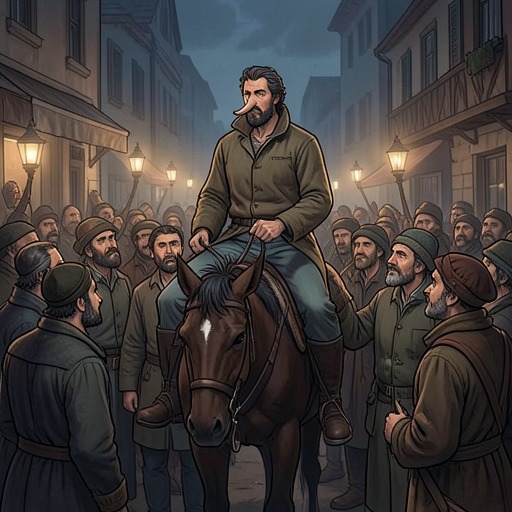
The Life and Opinions of Tristram Shandy, GentlemanThe Strasbourg nose uproar and French capture is the central reversal in Hafen Slawkenbergius’s tale of a stranger whose extraordinary nose grips an entire city. What begins as a brief encounter at the gate becomes a month-long public obsession; when the people of Strasburg leave the city to pursue the promised sight, the open gates allow the French to enter. The episode makes curiosity both the immediate cause of civic abandonment and the satirical explanation for Strasburg’s later decline.
The Stranger and the First Report
At the end of a sultry August day, a stranger rides into Strasburg on a dark mule, carrying a small cloak-bag with a few shirts, shoes, and crimson-satin breeches. When questioned by the sentinel, he says he has come from the Promontory of Noses, is bound for Frankfort, and plans to return to Strasburg a month later on his way toward the borders of Crim Tartary. The sentinel looks at his face and sees a nose unlike any he has encountered. A remarkable feature, a traveler passing through, and a definite return date are enough to set the story in motion.
The stranger’s own conduct adds to the uncertainty without resolving it. He vows that his nose will not be touched until an hour or destination he does not name; when pressed to say when, or where, he rides away without answering. The tale makes the withheld explanation an engine of expectation: the citizens have not established what the nose is, what the vow means, or whether the feature is genuine, but the unanswered questions intensify their desire to see it.
A City Reorganized by Curiosity
Before the stranger has gone half a league toward Frankfort, Strasburg is in uproar. The Compline bells ring while the people, absorbed in the news, hurry from street to street asking who saw the nose. Those who were at prayer, washing, starching, scouring, or quilting lament that they missed it. The ordinary duties of the evening become a catalogue of opportunities lost to curiosity, while the bells continue to mark a religious routine that no one seems to heed.
The disturbance reaches beyond the first crowds and becomes the subject of nearly every conversation. The narrator describes people of all ranks and callings listening for news, every eye longing to see the stranger and every finger eager to touch his nose. The bakeries, too, suffer a practical consequence: in the confusion the bakers forget to set their leaven, and there are no buttered buns for breakfast. The episode thus measures the uproar both by its extravagant public scale and by its small, material interruptions to daily life.
The reports about the stranger do not agree on what his nose is like. The sentinel, the drummer, the trumpeter and his wife, the burgomaster’s widow, and the innkeeper’s household differ in their descriptions, but agree that the stranger has gone to Frankfort and will not return until the appointed day a month later. They also agree in praising his appearance and manner: he is described as handsome, well made, generous, and courteous. The incompatible testimony does not diminish the city’s interest. Instead, the gap between uncertain accounts and confident anticipation keeps the nose at the center of public attention.
The Return Date and the Mass Departure
The tale makes the delay part of the event’s force. The people endure twenty-seven days of expectation, during which Slawkenbergius says they neither eat, drink, sleep, nor pray properly. The narrator frames this as a mock encomium to a city whose curiosity has been stretched almost to the limit: the citizens have been given a precise date, and their collective attention fixes on it.
On the twenty-eighth day, the stranger has promised to return. At sunrise, an immense procession sets out to meet him. Slawkenbergius lists seven thousand coaches, fifteen thousand single-horse chairs, and twenty thousand wagons, numbers the surrounding narration itself treats as suspect, and fills them with senators, counselors, religious women, widows, wives, virgins, canons, and others. The abbess of Quedlinburg and her attendants lead in one coach, while the dean of Strasburg and senior members of his chapter ride at her left; the rest follow by coach, on horseback, or on foot, in a disorderly mass. The extravagant figures and mixed procession turn the city’s departure into the tale’s comic climax, but its consequence is grave: the people leave the gates open.
Slawkenbergius calls this the catastrophe of a carefully structured tale, in which the successive parts lead into one another. The form underlines the causal chain: a nose attracts attention, the stranger’s promise prolongs it, and the appointed return brings the citizens out of the city together. The episode’s comic accumulation of witnesses, vehicles, and ranks therefore prepares the decisive political reversal rather than standing apart from it.
The French Enter and the City’s Decline
The tale places the capture against competing explanations of Strasburg’s fate. One historian blames the city’s pride in its freedom: its people regarded an imperial garrison as an affront and consequently fell to a French one. Another points to financial mismanagement, arguing that anticipated revenues, taxation, and exhaustion had weakened the city until it could no longer keep its gates shut. Slawkenbergius offers a more pointed account. The French, he says, see the people of Strasburg marching out after the stranger’s nose and enter through the gates they have left open. The French take advantage of the opening, but the tale assigns its immediate cause to the citizens’ collective pursuit.
The consequence persists beyond the moment of capture. Trade and manufactures decay gradually, not, Slawkenbergius insists, for the reasons commercial commentators have supplied, but because noses have so occupied the Strasburgers’ minds that they cannot attend to their business. His final image of fortresses won or lost by noses enlarges the joke into a political judgment: what seems like an absurd distraction can become a vulnerability with material consequences.
Narrative Significance
As a tale within the novel, the Strasburg episode turns an individual physical peculiarity into a public event and then into a civic explanation. Its crowd scenes widen outward—from the sentinel’s report, to street-by-street rumor, to mass departure—while the unanswered question of the nose’s nature remains unresolved in the evidence presented here. The distance between what the citizens claim to know and what they can actually establish is central to the episode’s irony: uncertainty does not check the crowd but draws it together.
The story also sets the city’s fate beside the ordinary forms of attention it neglects. The Compline bells ring unheard, bread is missing from breakfast, and public institutions join the procession rather than hold the city in place. The nose is the focus of the spectacle, but the decisive object is the open gate. By making curiosity the force that leaves it unguarded, Slawkenbergius converts a comic obsession into an account of how collective distraction can expose a community to capture and long-term economic loss.